
Over the years I have been creating lots of confusing, busy yet at the same time, meaningful and insightful emergent media diagrams. These attempt to help the uninitiated heritage media folk, get to grips with a multiplatform, shifting-social-media-sands, transmogodified entertainment landscape…breathe.
So I have been uploading a bunch of these diagrams onto my flickr account over the past weeks, partly to make them more accessible to me too (oh the joys of the cloud) but with the creative commons tag, for all and sundry to use (attributed of course – the only way to power & fame nowadays – cackles!). Here is a short selection of the 25 or so already up, with brief descriptions – the main bunch is in a set called ‘Emergent Media’ here.
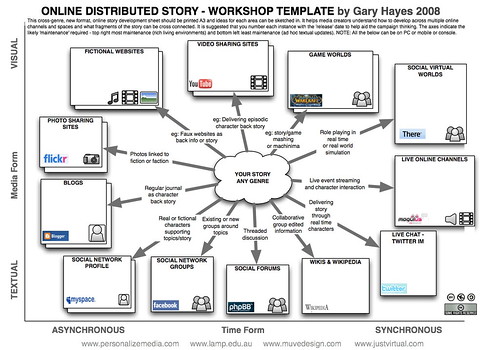
The above diagram is intended to help storytellers simply understand a range of key places to distribute their story fragments or triggers online. I always aim to have x and y axes and here I decided to differentiate these ‘social media services’ by time vs richness. So x axis is ad hoc dip-in-out through to realtime/live and y axis is basic text through to video/games etc: It would be possible to do a quick ‘sketch’ user journey here too by adding sequential numbers to the ‘notes’ one puts in the boxes.
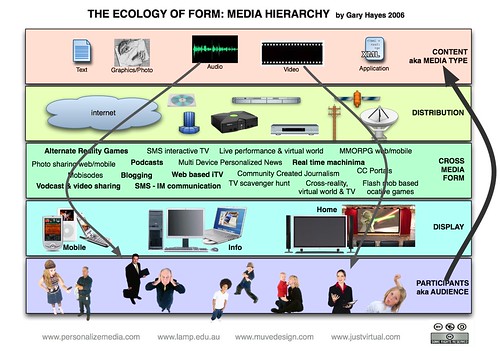
The above is one of my favourite diagrams from way back in early 2006. I normally present this by saying in looking at ‘form’Â lets not follow red-herrings by only looking at the content type, or distribution channel, or display – but mostly at the audience and the cross-media form. The arrows there indicate the participatory audience pushing content up to the top and it filtering down onto the three screens – mobile, informational and home (phone, pc, tv ish)
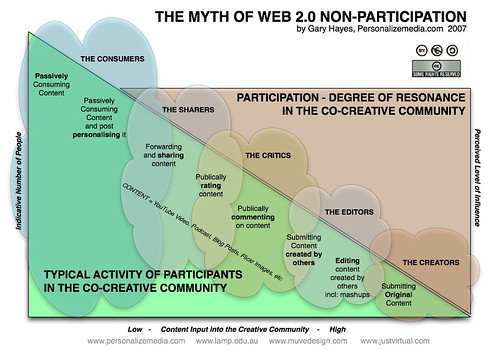
This was a diagram I threw together at Bangkok airport believe it or not early in 2007Â – simply looking at the influence that people have in the sharing web. It is intended to show a whole bunch of ‘indicative’ ideas about the proportional numbers who contribute to web 2.0 through to the influence each category of users have on it – I also invented in my jet-lagged haze five categories, The Creators, The Editors, The Critics, The Sharers and The Consumers. This was discussed here on this blog and heavily dugg too last year.
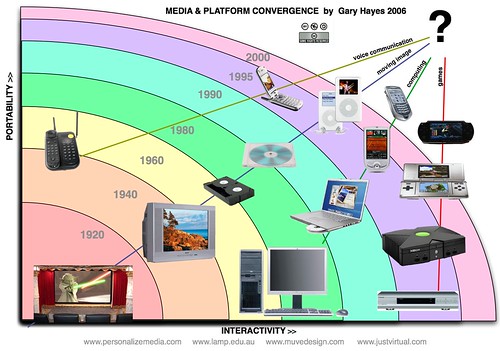
A convergence viewpoint (and yes I know the C word is bad!) But I re-discovered this diagram and the thing that stood out for me was OMG everything seems to be pointing towards the iPhone! Yes games, information, video and telephony all combined into one device…I wonder if Apple nicked this 🙂 But thing that stood out for me was the developments in 100 years from only cinema through to a device you hold in your hand that now combines potentially everthing (to a lesser or greater degree). My original post this is on here Media Journey’s Pt 2
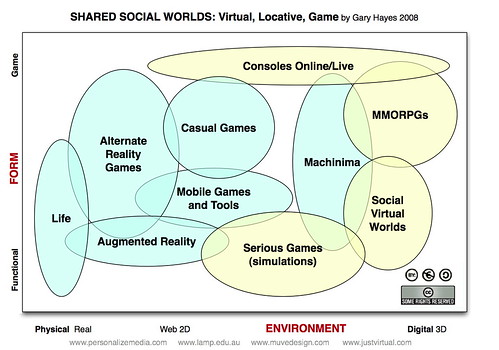
A relatively recent diagram when I was trying to get my head across ‘shared worlds’. I often get asked about shared worlds being just game worlds (WoW or Second Life) but of course it extends across a whole genre of services online. I didn’t include the shared worlds of email/forums/twitter etc etc but concentrate on worlds specifically aimed at stories or games for this particular chart. The ubiquitous x and y axes here are about x – physical to digital 3D and y – Functional to Game. It is therefore easy to map ‘real life’ at bottom left as physical/functional while top right digital and game as being the traditional MMORPG.
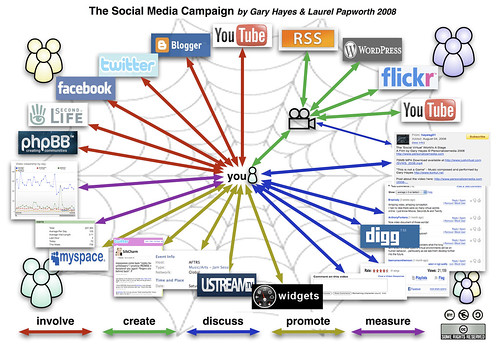
Finally couldn’t post diagrams without a very recent one I did with the wondrous and exquisite Laurel Papworth which merges the above thinking with how to promote and reach out across the vast landscape of social media. Here is a description from the flickr photo that has already had 1600 views or so.
By Gary Hayes and Laurel Papworth – From a presentation I gave at SPAA Fringe on Saturday 25 Oct 2008 in Sydney. Concepts behind this covered in the slides embedded on www.personalizemedia.com/the-future-of-social-media-enter…
* INVOLVE – live the social web, understand it, this cannot be faked
* CREATE – make relevant content for communities of interest
* DISCUSS – no conversation around it, then the content may as well not exist
* PROMOTE – actively, respectfully, promote the content with the networks
* MEASURE – monitor, iteratively develop and respond or be damned!
As I said there are many more on my flickr account and will be adding another 30 or so old archive ones in the next months.



Thank you for making these available. I am writing a unit of work for Year 9 and 10 students who are about to receive their personal laptops in public schools in NSW. The unit of work’s core question is \How are digital technologies used to persuade?\. I will be suggesting this blog as a resource for teachers and using your diagrams in the student materials, acknowledged ofcourse.
My pleasure Prue. Hope they find them useful, a new batch will be added soon too. Thanks also for spreading this blog around 🙂
This will be a very new area for English teachers and I’m trying to educate myself before I have to educate them! The laptop program is going to change a lot of things at school. Your blog has been most helpful. Thanks again.
Hi Gary,
Love your diagrams, you always have good ideas for presenting complex information in diagrammatic form. I have a couple of questions to ask and I hope you don’t mind:
1)I would love to use a couple of your diagrams in my book, and I wondered if you would mind. Needless to say they would be fully attributed.
2)Which kind of software are you using to create these diagrams? Is it free software or would I have to buy it? If the latter could you give me the details?
Thanks
Sincerely
Xuemei
Hi Xuemel,
Very happy for you to use these diagrams attributed in your book. I tend to use the Mac OmniGraffle to make them although some are created raw in keynote.
THanks for the comment!
Gary Hayes’s last blog post..Talk: The Fragments of Play – Transocialmedia Entertainment
Been out there a while, just stumbled across these complex social media diagrams. Very insightful. cli.gs/0E2Gm
RT @pokenzoo: Been out there a while, just stumbled across these complex social media diagrams. Very insightful. cli.gs/0E2Gm
This post is very informative and also all the diagrams are very attractive one can easily understand the topic.The above diagram is intended to help storytellers simply understand a range of key places to distribute their story fragments or triggers online
.-= Mio Navman Spirit S500THF´s last blog ..Hi all! =-.
Multi platform Social Media www.personalizemedia.com/multi-platform-social-media-diagram-by-diagram/
RT @ludgirardi: Multi platform Social Media www.personalizemedia.com/multi-platform-social-media-diagram-by-diagram/
RT @garyphayes Multi Platform Social Media – diagram-by-diagram | PERSONALIZE MEDIA is.gd/mvlb
Multi Platform Social Media – diagram-by-diagram | PERSONALIZE MEDIA bit.ly/coyBNT RT @garyphayes Keep coming back! #socialmedia
Multi Platform Social Media – diagram-by-diagram | PERSONALIZE MEDIA t.co/Gx9Y48F
Multi Platform #Social Media – diagram-by-diagram t.co/lzIUeRn #juandon #comunicacion #news #guardian
dld.bz/– Multi Platform Social Media – diagram-by-diagram t.co/0hvOdfx via @garyphayes ow.ly/1bDALQ
dld.bz/– Multi Platform Social Media – diagram-by-diagram t.co/0hvOdfx via @garyphayes ow.ly/1bDALO
#Learning more about >> Multi Platform Social Media – diagram-by-diagram | PERSONALIZE MEDIA t.co/FHRGr5Ps #marketing #social
Archive: : Multi Platform Social Media – diagram-by-diagram t.co/K0nyKAMw
Archive: : Multi Platform Social Media – diagram-by-diagram t.co/K0nyKAMw
Archive: : Multi Platform Social Media – diagram-by-diagram t.co/K0nyKAMw
“@GaryPHayes: Archive: : Multi Platform Social Media – diagram-by-diagram t.co/ZgcFBm5Y”
#transmedia